

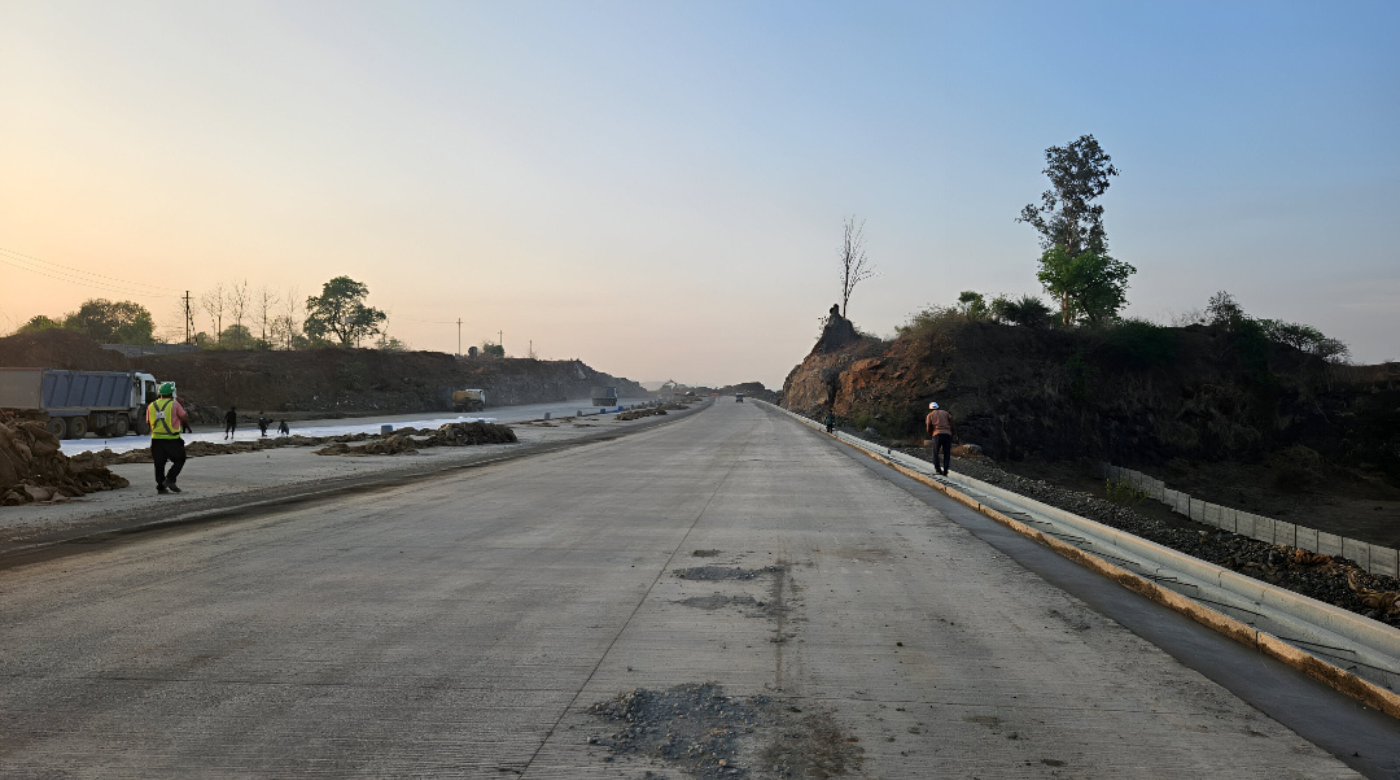
India is in the middle of a transport revolution. High-speed expressways are transforming how people and goods move across the country. One of the most important of these projects is the Mumbai–Vadodara Expressway, a key part of the larger Delhi–Mumbai Expressway corridor. Once complete, this route will reduce travel time between Mumbai and Delhi by several hours, boost trade, and connect industrial hubs across Gujarat and Maharashtra.
At the heart of this massive project are many contractors and subcontractors who together bring it to life. Among them, Vijay V. Patel Infrastructure Pvt. Ltd. (VVP Infra) has played a vital role by delivering some of the most critical groundwork required for the expressway.
About the Mumbai–Vadodara Expressway
The Mumbai–Vadodara stretch is one of the busiest transport corridors in India. The new expressway is designed as a greenfield, 8-lane, access-controlled highway. It is being built to international standards, ensuring safer, faster, and more efficient movement of vehicles.
Some highlights of the expressway:
- Length: About 380 km between Mumbai (Maharashtra) and Vadodara (Gujarat).
- Part of: The Delhi–Mumbai Expressway (DME), India’s longest expressway, covering 1,386 km.
- Impact: Reduced travel time between Delhi and Mumbai from 24 hours to around 12 hours.
- Economic Role: Connecting major industrial cities like Surat, Bharuch, Valsad, and Mumbai, while improving logistics for ports and manufacturing hubs.
V.V. Patel Infrastructure’s Contribution
Large infrastructure projects like this require teamwork across multiple packages. V.V. Patel Infrastructure has been trusted as a subcontractor by leading companies such as:
- G R Infraprojects Limited
- IRB Infrastructure Developers Ltd.
- Montecarlo Limited (MCL)
Across these collaborations, VVP Infra has executed earthwork, subgrade preparation, and GSB (Granular Sub-Base) works—the foundation layers that form the backbone of the expressway.
1. Earthwork
The first step in expressway construction is preparing the ground. This involves:
- Clearing and leveling the land.
- Excavation and filling to create a stable embankment.
- Ensuring proper slope for drainage and durability.
VVP Infra deployed advanced machinery and skilled manpower to complete large-scale earthwork between Gandeva, Ena, and other stretches. This provided a stable platform for higher layers of the expressway.
2. Subgrade Preparation
The subgrade is the soil layer just below the pavement structure. Its quality directly affects the lifespan of the road. VVP Infra worked on compacting and stabilizing the soil to meet strict technical standards.
By achieving the right density and strength, the company ensured the expressway could handle heavy truck traffic for decades without premature damage.
3. GSB (Granular Sub-Base) Work
On top of the subgrade comes the GSB layer—a mix of crushed stone and gravel. This layer distributes vehicle loads and prevents the road from cracking.
VVP Infra executed high-volume GSB works, supplying and laying thousands of cubic meters of material. Precision was key, as each layer had to meet exact thickness and compaction requirements.
Overcoming Challenges
Working on such a mega project is never easy. VVP Infra had to manage:
- Strict timelines set by the National Highways Authority of India (NHAI).
- Coordination with multiple prime contractors across different packages.
- Weather challenges, especially during monsoon seasons.
- Logistics, ensuring continuous supply of stone, gravel, and earth material.
Through strong project management and experience in large-scale infrastructure, VVP Infra delivered quality work within deadlines.
Impact of the Project
The Mumbai–Vadodara Expressway will:
- Cut travel time between Mumbai and Vadodara from 6 hours to just about 3 hours.
- Boost trade by connecting ports like Hazira, Nhava Sheva, and Dahej.
- Create jobs during and after construction through logistics, tourism, and industries.
- Improve safety, thanks to better road design, controlled entry/exit, and modern toll systems.
By contributing to this project, VVP Infra has helped build an expressway that will serve millions of people and businesses for decades.
Conclusion
The Mumbai–Vadodara Expressway is more than just a road—it is a lifeline for India’s economic growth. Behind its smooth asphalt are layers of hard work, from earth moving to final finishing.
Vijay V. Patel Infrastructure Pvt. Ltd. is proud to have contributed as a subcontractor to GR Infraprojects, IRB Infra, and Montecarlo Ltd., delivering earthwork, subgrade, and GSB works with precision and reliability.
This project reflects the company’s growing role in nation-building, showing how dedicated regional contractors can play a part in shaping India’s future infrastructure.